What I Learned at FinTech Innovators’ Hackathon 2026
- hackathon
- fintech
- ai
Introduction
Over the recess week, my friends and I participated in the FinTech Innovators’ Hackathon 2026, hosted by the NTU Nanyang FinTech Catalyst.
As this was my first hackathon in university, I had no idea what to expect — late-night debugging sessions, rapid prototyping, and trying to turn an ambitious idea into a working product within a week.
In this post, I will be sharing the product we built, the technologies we used, the challenges we faced, and what I learned from this one-week experience.
The Problem Statement
We chose the “Wealth Wellness Hub” problem statement because we felt that many people struggle to manage their finances across multiple platforms. Investments, savings, budgeting, and spending analytics are often separated across different apps, making it difficult to get a clear overview of one’s financial health.
Our goal was to create a centralized platform that simplifies financial management while also providing intelligent insights powered by AI.
Our Solution
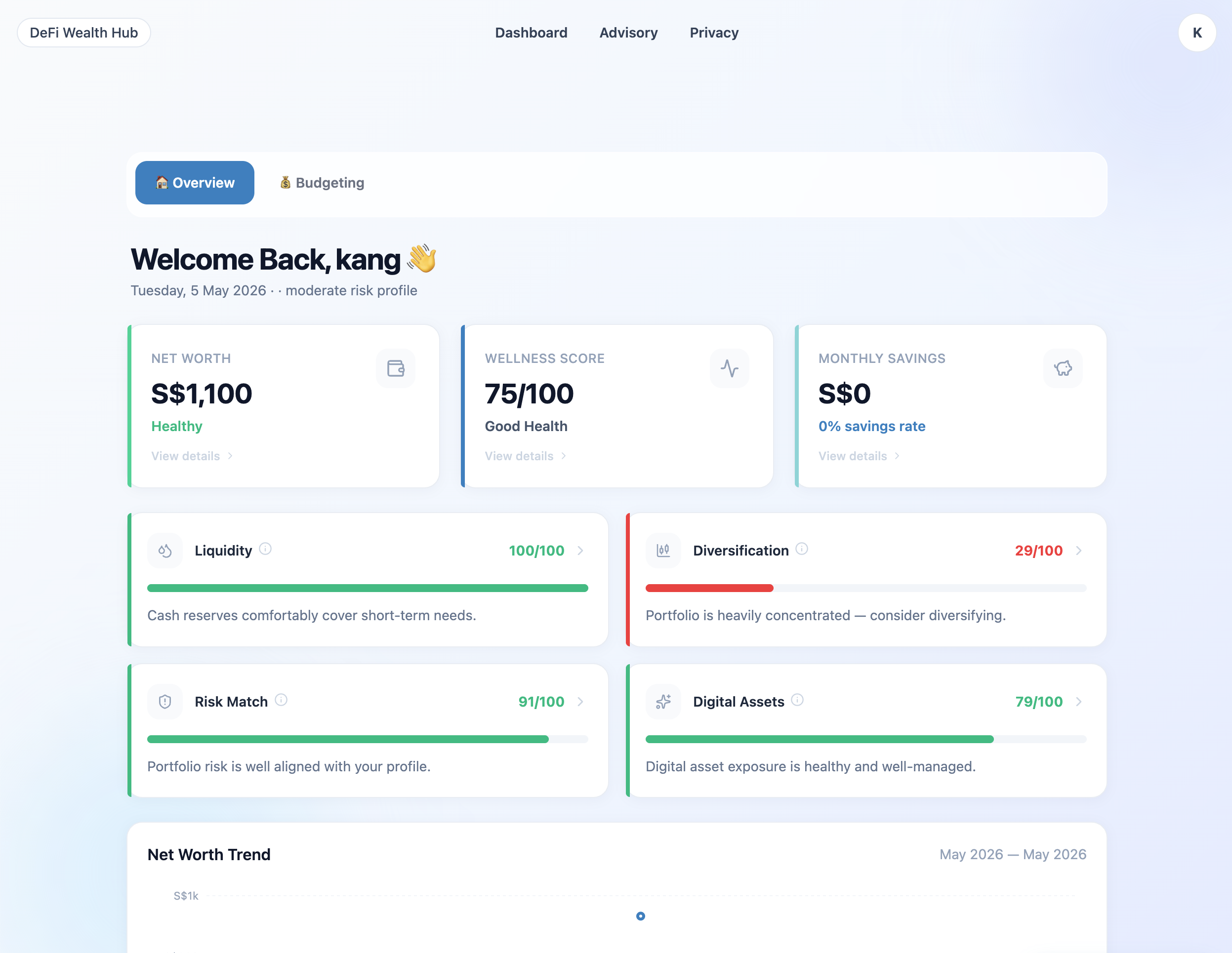
To address this problem, we developed DeFi Wealth Hub, an AI-powered financial dashboard designed to give users a unified view of their financial portfolio.
Instead of switching between multiple banking, budgeting, and investment platforms, users can monitor their finances in a single interface while receiving personalized recommendations generated by AI.
- Portfolio Overview: A comprehensive overview of your assets, including their current value, market value, and percentage change.
- Asset Breakdown: A breakdown of your assets by category, including total value, market value, and percentage change.
- Live Asset Tracking: A real-time tracking of your portfolio's performance, including total value, market value, and percentage change.
- Budgeting: A budgeting tool to help you manage your spending and stay on top of your financial goals, as well as providing a 6-months emergency savings goal.
- Transaction Tracking: As part of the budgeting tool, you can track each and every transactions from income statements and email imports.
- Wealth Advisory: A personalized wealth advisor using Groq LLM that provides personalized recommendations and insights based on your portfolio.
- Portfolio Management: Tools to manage your portfolio, including adding, removing, and updating assets.
Tech Stack
- Frontend: React, Tailwind CSS, TypeScript, React Router
- Database: Firebase Firestore
- AI: Groq, Claude
Challenges Faced
1. AI-Generated Code Breaking Existing Features
Since we relied heavily on Claude to accelerate development through vibe coding, we quickly encountered one major issue: fixing one feature would sometimes unintentionally break another part of the application.
For example, while implementing a feature to visualize the liquidity and diversity of a user’s assets, parts of the dashboard UI began to malfunction and stopped synchronizing properly with the data fetched from Firebase. Although Claude was able to generate large amounts of code quickly, the generated implementations occasionally introduced conflicting logic, inconsistent state management, or unintended side effects across components.
As the project grew in complexity, debugging these issues became increasingly challenging because changes made in one area could unexpectedly affect unrelated features elsewhere in the application.
This experience taught us that while AI tools can significantly speed up development, they still require careful review, testing, and architectural planning to ensure long-term maintainability.
2. Understanding and Maintaining The Code
Another challenge we faced was understanding the structure and logic of the code generated by Claude.
When writing code manually, developers usually have a clearer understanding of the application flow and design decisions. However, AI-generated code often introduced multiple layers of abstraction, additional helper functions, and fragmented file structures that made the codebase harder to navigate.
At times, Claude would generate entirely new components or utility files for relatively small features, which increased the overall complexity of the project. This made debugging more time-consuming, especially under the limited timeframe of the hackathon.
As a result, we learned the importance of balancing AI-assisted development with our own understanding of the system architecture. AI can accelerate implementation, but developers still need strong fundamentals to effectively debug, refactor, and maintain the generated code.
3. The Final Crunch
Because of the issues caused by unstable AI-generated code and the complexity of understanding the rapidly growing codebase, the final few hours before submission became extremely intense.
Our team stayed on campus until around 10pm, focusing entirely on debugging, fixing broken features, and ensuring the application was stable enough for the final demo. At that stage, even small changes could unexpectedly break other parts of the system, so we had to carefully test every feature after each modification.
Despite the pressure and exhaustion, this was also one of the most memorable parts of the hackathon experience. Watching the project gradually come together after hours of troubleshooting felt incredibly rewarding, especially knowing that we had started with only an idea a week earlier.
The experience taught me how important teamwork, communication, and prioritization are in fast-paced development environments. In hackathons, perfection is rarely possible. Sometimes the biggest challenge is simply getting everything working reliably before the deadline.
Post-Hackathon Reflection
Overall, I am extremely proud of what our team managed to accomplish within such a short timeframe. What started as a simple idea eventually evolved into a fully functional AI-powered financial dashboard, and being able to present a working product at the end of the hackathon felt incredibly rewarding.
Although we finished as runner-ups, I still consider the entire experience a personal win. As my first university hackathon, it exposed me to rapid product development, teamwork under pressure, and the realities of building software within tight deadlines. Throughout the one-week journey, I learned far more than I initially expected — not just technically, but also in terms of collaboration, communication, and problem-solving.
One of my biggest takeaways from this experience was understanding the role of AI in modern software development. While tools like Claude significantly accelerated our workflow and helped us prototype features quickly, we also realized that relying too heavily on AI-generated code could introduce maintainability and debugging challenges.
In the long run, I believe the most effective approach is a balance between human-written and AI-assisted code. AI can greatly improve productivity and speed up development, but strong technical fundamentals and human oversight are still essential for writing reliable, maintainable, and scalable software.
Moving forward, I am excited to participate in more hackathons and tech-related competitions whenever time permits. This experience has not only strengthened my interest in software development, but also showed me how much can be accomplished through teamwork, rapid iteration, and creativity under pressure.
As for DeFi Wealth Hub, I hope that our team will one day revisit the project and continue building upon the foundation we created during the hackathon. With more time and development, I believe the platform has the potential to evolve into a far more robust and feature-rich financial management solution.